
Can Science Communication Pay for Itself?

Can research briefs be marketing collateral? Yes!
Science funding is in the toilet this year, so what’s a small consultancy to do when a big research programme ends and there’s barely anything left in the budget for communication?
We encourage all research programmes to allocate around 5% of their budget to communications and engagement (backed by research from Ceridwyn Roberts). Kōmanawa Solutions had set a decent budget aside at the start of their programme – but over time, the fluid research budget had eroded the comms budget line. (Unfortunately for us science communicators, this is an extremely common phenomenon!)
Kōmanawa went for some creative problem-solving: plain-language research summaries that doubled as marketing collateral.
What we did
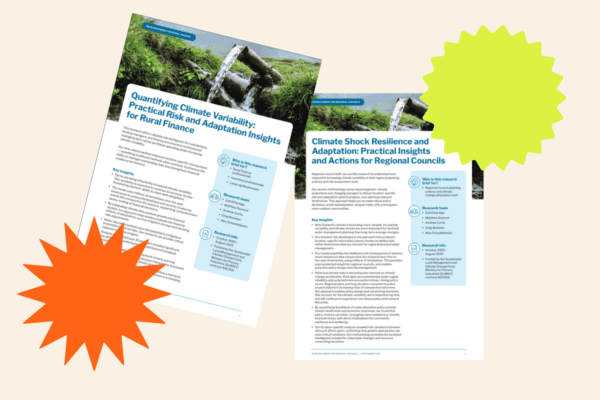
Shared Science’s Annabel McAleer worked with Zeb Etheridge and Matt Dumont at Kōmanawa to create two research briefs summarising their Climate Shock, Resilience and Adaptation project. One was aimed at regional councils, the other at the financial sector.
Each document had to do two jobs: communicate relevant research findings to end-users, and describe what more Kōmanawa could do if the reader became a client.
A hard-sell wasn’t the right approach. The focus was on clearly communicating important research findings with immediate interest and value, showing how those findings could support decision-making for each audience. The business development element was confined to the back page, where we outlined the additional services Kōmanawa could offer.
How we worked
The science programme had produced three journal articles (one published, one in review, one still being written). We worked with all three outputs along with client interviews to draft the research brief for regional councils.
For banks, the use case was less obvious in the source material. The Kōmanawa project team applied their industry knowledge to identify relevant applications of the work, then worked with AI to generate a summary as a starting point. Shared Science then created the research brief, editing and re-writing AI content to sound more human.
AI had introduced North American terminology, so Shared Science in turn used AI to ‘Kiwify’ the language, training it on sources from New Zealand banks to use appropriate terminology. ‘Financier’ became ‘lending manager’ to match the language actually used by New Zealand banks, for example. We removed other specialised terminology where possible in favour of plain language, our usual approach for any audience.
Then we had to cut AI out of the loop. That’s because AI will cheerfully suggest edits for any document you’re reviewing, even if that content has already been edited and checked. If AI re-writes unnecessarily, a human then needs to edit again to remove the AI ‘tells’ that can be off-putting to many readers. No one wants an infinite AI editing loop, so we transparently agreed to amicably divorce AI from the project, and finished with a final human-edited version.
Results
The research briefs opened doors to conversations with 7 potential clients across the regional council and finance sectors, fed useful plain language explanations into national and international conference presentations, and generated 17 media stories, including an RNZ article syndicated into the print editions of 8 regional newspapers.
(You can read the plain-language research briefs for rural lenders and regional councils here, and check out some of the media coverage here).
“After working on this research project over multiple years, generating large arrays of complex data and exploring our research questions from various angles, it was hard to see the wood for the trees when it came to key messages for end users. Annabel patiently guided us through those reflections and landed a press release that caught media interest without sensationalising the work. The outcomes exceeded our expectations by an order of magnitude.”
Zeb Etheridge, Kōmanawa Solutions
What we learned about climate change and farming
Curious about the research itself? Here’s some interesting stuff:
- Climate change is usually talked about in long-term averages, which gives the impression of a slow increase in temperature over time. But we experience climate change day-to-day as an increasingly variable climate, not a warming one. (Hello, disappointing Kiwi summers of 2025 and ’26.)
- Canterbury farmers have been shielded from the worst effects of climate change because they’ve been able to irrigate pretty freely in many areas. But as river flows and aquifer recharge become more variable, that’s likely to change.
- A more variable climate means increasing financial risks. For irrigated dairy farms, climate variability can combine with global financial volatility to create a “perfect storm” that increases the risk of missed debt payments and insolvency.
Working with a tight comms budget? Let’s talk about making your research support your business development. Get in touch, or follow our work on LinkedIn

Author: Annabel McAleer
I’m a giant nerd when it comes to turning research into real-world benefits. My specialty is translating complex scientific information into actionable insights that make a difference.
Author
Summary
- Plain-language research briefs can do double-duty as business development collateral, making the fullest possible use of limited comms budgets.
- Strategic AI use accelerated initial drafts and helped ‘Kiwify’ banking terminology by training on New Zealand financial sector sources.
- Transparency around AI use prevented infinite editing loops and ensured natural, authentic language was preserved.
Enjoying our content?
Get it straight to your inbox